
Where has it appeared?
Build a list of unique pages and direct image URLs rather than counting repeated thumbnails.
Trace an image toward its earliest credible publication, creator, licensing source, or documented chain of reuse using verifiable source evidence.
5 focused guides in this learning path
Browse all topics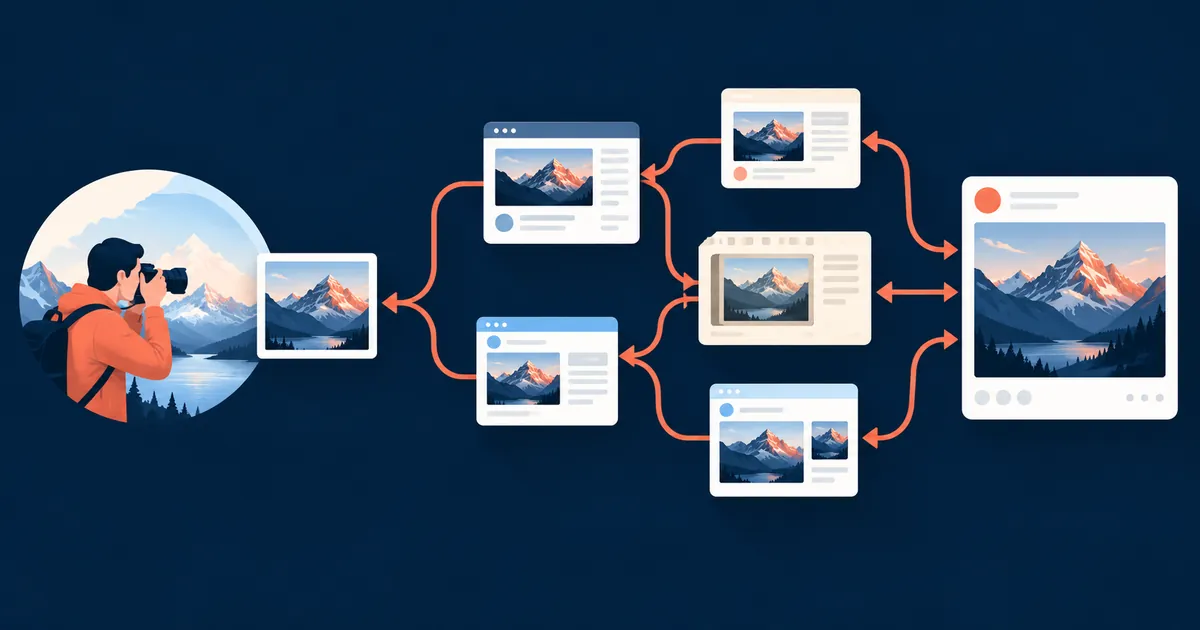
Source tracing is an evidence problem. A useful conclusion combines visual matches with publication records, credits, file quality, and independent context.
Build a list of unique pages and direct image URLs rather than counting repeated thumbnails.
Prefer documented dates, named creators, fuller context, larger files, and independent corroboration.
The earliest indexed result may still be later than the first publication or copied from an offline source.
A search engine's first-seen date records when that engine found a file. It is not necessarily the capture date or first publication date. Use the Image Source Finder to organize candidate appearances, use Find Similar Images when the query is visually related rather than identical, then apply the image-date verification workflow to page timestamps, archive captures, creator credits, captions, and references between publishers.
| Level | Evidence | What it supports |
|---|---|---|
| Appearance | A matching image on a reachable page | The image appeared at that URL when observed |
| Documented publication | Reliable timestamp, named publisher, stable context | A dated use by that publisher |
| Attributed source | Creator or agency credit supported elsewhere | A credible attribution lead |
| Original record | Creator archive, assignment record, original file, or authoritative catalog | A much stronger claim about origin |
Record the query version, provider, access date, result URL, direct image URL, displayed date, creator credit, and image dimensions. This lets another researcher repeat the path and challenge a weak step without starting over. When captions and image templates have separate histories, use the meme source-tracing workflow to document each layer independently.
Build a source trail from matching pages, dates, credits, crops, and file evidence.
Trace an image toward its earliest credible publication, creator, licensing source, or documented chain of reuse using verifiable source evidence.
Trace provenance with dated pages, image dimensions, credit lines, archives, and a documented confidence score.
Estimated reading time: 9 minutes.
Use a query ladder that moves from the whole image to distinctive details without confusing similarity with duplication.
Estimated reading time: 7 minutes.
An attribution ladder combining reverse search, credit lines, metadata, stock collections, publication history, and creator confirmation.
Estimated reading time: 10 minutes.
A meme lineage method that searches template and text layers independently instead of treating every repost as the same artifact.
Estimated reading time: 9 minutes.
A crop expansion ladder for tracing thumbnails, profile crops, collage panels, and partial screenshots back toward larger images.
Estimated reading time: 8 minutes.